August 8, 2026
Memory Is the Mother of the Muses (and Other Things the Capacity Race Forgot)
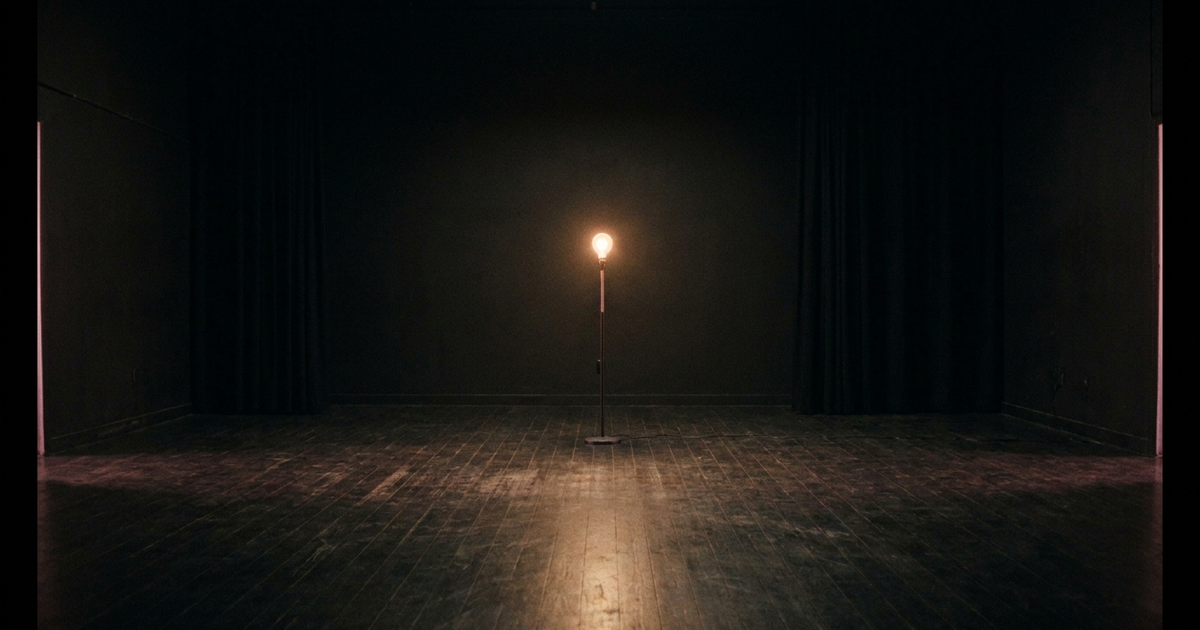
In improv, every scene dies. When the lights go down, whatever happened on that stage is gone. You can't save it, can't replay it, can't get it back. And that's how it's supposed to be. The moment is the point.
Ask anyone who's played in an improv troupe, the kind that rehearses together for years, and they'll tell you the scene was never the work. The work is what the group carries. The callbacks. The shared vocabulary you build over hundreds of shows. The knowledge that when your scene partner steps forward with that particular look on her face, you know exactly where she's going, because you've been there with her a hundred times. A great improv company can walk on stage with nothing and build something out of thin air. Not because the moment is magic. Because the memory is. The troupe is a memory system with a stage attached.
I know this because I built one. For nearly a decade, I ran a theater in the shadow of big comedy institutions, a stage for the underrepresented, a home for the non-linear, a place where people who didn't fit anywhere else could find their voice. We were small and weird and we survived on the strength of what we held together.
Now I build AI systems. And the strangest thing about this industry, watching it from inside, is that it's building infinite stages with no troupes.
Look at where the energy is going. One million token context windows. AI labs pushing for twelve million. Every major lab is in a capacity arms race, trying to solve the problem of forgetting by brute force. The industry has moved past the idea that AI is a coding tool. The ambition now is cognitive infrastructure for everything, a system that can hold the weight of a working life or maybe just life.
A bigger context window is just a longer scene. The lights still come down at the end.
Every conversation with an AI starts the way a pickup improv team starts. Talented strangers, zero history. You spend an hour getting an assistant up to speed on your project, the constraints, the stakeholders, the decision you made last Tuesday and why, and the session is genuinely good, and then you close the tab and the whole thing evaporates. Tomorrow you start over with a performer who has never met you.
That's the paradox. We generate more data than any humans ever have, and our history has never felt more ephemeral. Drowning in information, starving for meaning. The data points we use to define our working lives are constantly overwritten, updated, deprecated, rendered obsolete by the next model release. If memory is built on shifting sand (changing models, changing APIs, changing terms of service), it can't be a foundation for anything.
Memory without stability is just noise.
building it myself
So I built one.
I didn't plan to. About a year ago I was just trying to get work done across a half-dozen AI tools, and I kept hitting the same wall: everything I worked out with one assistant died with that session. So I started writing things down. Then I started making what I wrote down searchable. Then I made the searching automatic. The system that accreted around that work, a thing I call Syn, is now the most load-bearing piece of technology in my life.
I'm going to break the theater metaphor for a minute, because I want to give you the backstage tour.
Memory needs to live outside the model. You do not want it in a chat log or in one vendor's memory feature. My working context lives in a git-backed repository of markdown files and a local self-hosted knowledge graph, a Memgraph database running on a Mac Mini in my home, mirrored to Typesense for semantic search. Meetings, decisions, people, projects, the reasoning behind calls I made months ago, stored as connected nodes instead of flat notes. Local-first. Completely private. Completely mine.
It loads like a card catalog, not a payload. The naive move is to stuff everything the system knows about you into every conversation. I tried that. It breaks. I once opened the file where my assistant keeps its index of me and found a warning at the top. The file had grown so large the reader had started chopping off the end. My index of everything worth remembering had run out of room to remember things. The fix was the librarian's fix.
I was a librarian before I was a theater person, and I have strong feelings about card catalogs. What I have is a tiny always-on core of who I am and a few hard rules. Then there are one-line pointers, like the back of a book. The actual content stays in the database, pulled only when needed. The card catalog stays small. The library can grow forever.
The retrieval is a reflex, not a request. I built all that storage and it still felt like my assistant had a bad memory, because it only searched when I explicitly told it to. The fix wasn't more storage or better storage. It was making the looking-up automatic. Now, every time I send a message, a hook fires so that it searches the graph, pulls the two or three most relevant facts, and hands them over before the model starts answering. Nobody has to remember to look. The right three facts instead of a drowning three hundred, every time, without being asked. When your AI's memory feels too small, the answer is almost never a bigger context window. It's better retrieval.
Then I made sure the loop closes itself. At the end of a real work session, my assistant writes its own short summary of what we did and what we decided, and files it into the searchable pile. Three weeks later, a future session can ask "what did we decide about pricing" and find the answer in its own words from the day we figured it out. A diary it keeps for itself. Anything I have to maintain by hand, I won't, so the system maintains itself.
I don't live in one vendor. I move between Hermes, Claude, Pi, Codex, and a rotating cast of local models on my own hardware, depending on the task. Because the memory isn't in any of them, it survives all of them. The information is able to travel and is not vendor locked. When a better model ships, I swap it out and keep the knowledge. When a vendor changes its terms, I lose nothing.
I keep comparing my setup to the repos and blog posts and product launches that get attention in this space, and I keep getting validated that the thing I built in my spare time, out of necessity, on hardware I own, is past most of what gets announced with fanfare. I don't say that to brag. I say it because memory should be what you own, not what the industry is incentivizing.
own your memory
Vendor lock-in is the death of creativity. I know this in my bones. A stage owned by a corporation that can change the rules overnight is not a sanctuary. It's a trap with good lighting. I spent ten years building the alternative to that, the small room where the unconventional could actually be heard.
The question gets genuinely strange with AI. The machine generates the output, but you provide the context. The model supplies the capacity; you supply the ten years of judgment, the stakeholder map, the reason the obvious answer is wrong. So who owns the soul of that work? If the memory of your voice, your decisions, your reasoning, your history, is trapped in a proprietary silo, you are losing your agency. You are losing your history. It's as if naming a model Fable was foreshadow.
This is why Syn's architecture matters more than its cleverness. Every layer of it sits on formats and hardware I control. Readable by anything, portable to everything. To refuse a single vendor is to refuse a single master. I didn't wait for the tech titans to figure out memory for me, and I didn't stay in their lanes. That's the rebel in me. My life has been non-linear paths and outsider status and a default setting toward open and transparent. But mostly it's structural. You cannot build a self inside someone else's product.
We are not building tools to be used by us. We are building vessels to be carried by us.
I've always been drawn to Mnemosyne. Partly the librarian thing. Mostly the theater. In the myths, she's not a filing clerk. She doesn't just keep the facts. She's the mother of the Muses. Memory, in the oldest framing we have, is not the archive. It's the source of the creative impulse itself. The Greeks understood something we've forgotten in the capacity race. You don't store the past for its own sake. You store it so something new can be born from it.
This is what the graph actually does for me. Syn maps knowledge as relationships: people, projects, decisions, the threads between them. Semantic search across that structure surfaces patterns my linear, tired mind would miss in the sheer volume. It doesn't just recall what I know, it shows me what I didn't realize I knew. A connection between a decision from March and a problem from June. A theme recurring across meetings I attended months apart. Recall becomes discovery.
That's the shift this whole thing is really about. From query-and-answer to context-and-wisdom. From a tool that responds to a partner with enough shared history to genuinely collaborate. When the callbacks are there, when the company remembers, when you can stop spending your energy holding everything and start spending it making something.
The cognitive load of the modern era is exhausting. We spend so much energy just trying to hold our lives, managing the notes, the tasks, the scattered context, the threads of yesterday, that we have very little left to actually live them. A mind without stable memory operates in constant survival mode. And anyone who has watched a loved one succumb to neurodegenerative disease knows what memory really is. It isn't a convenience. It is the person.
presence
The industry is building for a scale of data that exceeds a human lifespan. Infinite context, eternal archives, everything retained forever. They're optimizing for capacity.
I don't need an eternal archive. I need presence.
The improv stage taught me the value of the moment was never threatened by its impermanence. The company's memory is what made the moment matter. The goal was to build something when we would walk on stage with nothing and create something.
That's what I'm actually after. Not digital immortality. The security of knowing my history is held. The relief of not having to carry the weight of the past in order to face the present. When memory is secure, the mind is free.
The vessel lets me let go of the holding so I can focus on the being.
We build the vessel so we can journey through leadership, creation, and love with our context intact. We aren't merging with the machine. We're using it to reclaim our own humanity. The machine provides the scale and the speed. The human provides the meaning.
The lights will go down on every session, every model, every platform. But the company remembers. And when the company remembers, you can walk into each moment the way a great troupe walks on stage. Nothing in your hands, everything at your back. Present. Finally unburdened by the fear of forgetting.
LIKED THIS?
I write about AI in plain English every other Sunday. No hype, no jargon — just the stuff that actually helps.
I'M IN →